The trust gap: Why inventory accuracy has become retail’s biggest relationship problem
Retail inventory accuracy keeps shelves aligned with what systems report — reducing out-of-stocks, protecting sales, and improving customer satisfaction. Automated shelf visibility tools like inventory scanning robots help retailers capture reliable shelf-level data to close the trust gap.

Summary
Why do retailers lose trust when their inventory systems don’t match what’s actually on the shelf?
The Shelf Intelligence Report shows a widening “trust gap” driven by out-of-stocks, inaccuracies, and inconsistent execution that hurts shoppers, brands, and retailers. Because manual checks can’t keep up, retailers need objective shelf-level data—where automated capture like inventory-scanning robots can help close the gap.
Contents
Every relationship in retail depends on one deceptively simple expectation: that the shelf has what it's supposed to.
Customers expect the items they came for to actually be there. Brands expect the promotions they funded to be executed. Retailers expect their systems to reflect what is happening inside the store.
But the latest Shelf Intelligence Report from IHL Group shows something retailers have quietly suspected for years: shelf truths and system truths rarely match. And that disconnect has created one of the most underestimated problems in retail — the trust gap.
This isn’t a philosophical gap. It’s a measurable, operationally expensive, relationship-damaging gap that is reshaping buyer expectations, brand partnerships, and the true economics of store execution.
When accuracy slips, trust erodes
Inventory distortion — the combined cost of out-of-stocks and overstocks — now totals more than $1.7 trillion each year globally, notes the report. That’s roughly 5% of annual retail revenue lost to the mismatch between what systems show and what shelves actually have.
Inside that gap sits something far more consequential than missed sales. 67% of retailers report inventory-related issues on a weekly or near-daily basis. Half say they directly lose sales as a result. 47% see a rise in customer dissatisfaction. Nearly half (47%) report reduced engagement from brands, and 65% say these challenges create moderate to extreme strain with their brand partners.
When the shelf doesn’t match systems, the entire retail ecosystem feels the tension — shoppers, brands, and retailers themselves.
Shoppers learn quickly. After encountering out-of-stocks on just a few trips, they shift their loyalty elsewhere or turn to online ordering, often replacing in-store trips with recurring subscription services.
Brands feel the strain too. Promotional dollars and trade investments depend on execution accuracy. Yet average planogram compliance is stuck around 57%, with on-shelf availability at 58%, and promotional execution 60%. Fewer than a quarter of retailers achieve even 80% accuracy in any of these categories. For brands, this isn’t only a miss — it’s a signal that shared plans may not translate reliably to the store floor.
Retailers feel it last, but the impact is no smaller. Rising operational complexity combined with manual processes all contribute to a widening accuracy gap.
The reliability problem behind the trust problem
Today’s accuracy challenges intersect with staffing realities, legacy processes, workflow complexity, and shopper expectations in a way that makes the old model — periodic shelf checks and reactive fixes — fundamentally insufficient and high-fidelity visibility nearly impossible to maintain.
The trust gap is ultimately a reliability gap. And reliability depends on the quality, frequency, and objectivity of the data feeding decisions.
Why the fix hasn’t been a fix
The desire is there: 88% of retailers want inventory checks at least weekly, with many aiming for multiple checks each week.
But manual checks can’t scale to the frequency or consistency required. They vary by associate, shift, department, and store. They introduce gaps and blind spots. And they require labor that is rarely available at the consistent scale needed.
The data in retailers’ systems is only as reliable as the process that feeds them. Manual processes — no matter how diligent — can’t produce the shelf-level truth needed to restore trust.
Rebuilding trust requires better inputs, not bigger teams
Retailers that outperform on brand trust share one differentiator: better visibility.
The Shelf Intelligence Report shows a direct link between on-shelf availability accuracy and brand trust. Retailers that push accuracy above 70% see significantly higher trust from vendors, and are twice as likely to achieve brand trust scores above 75.
The reason is simple. When retailers have accurate shelf-level data, they can:
- Ensure the right products are on the shelf
- Execute planograms and promotions more reliably
- Meet brand expectations with fewer discrepancies
- Resolve issues before customers experience them
- Enter negotiations with objective, verifiable data
The foundation of trust is transparency — and transparency comes from objective, consistent measurement. This is where automated data capture with robots, computer vision, and RFID localization changes the game. They convert shelf conditions into repeatable, digital insights that retailers can act on, share, and build partnerships around.
How Brain Corp supports retailers in closing the trust gap
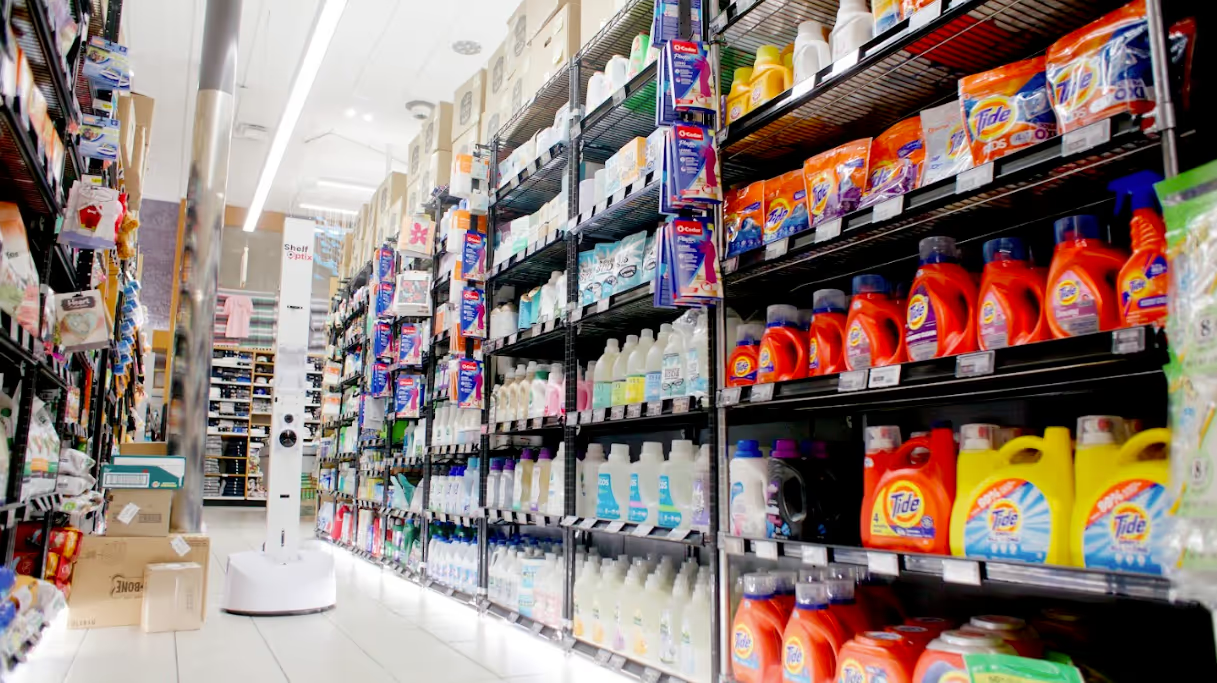
Ultimately, closing the trust gap comes down to having reliable, objective visibility into what’s happening on the shelf. That requires tools built for consistency, scale, and real-world store complexity — which is where Brain Corp’s autonomous inventory scanning robots fit into the picture.
Retailers typically approach this in one of two ways, depending on how they prefer to run their operations and manage technology.
Dedicated in-store scanning robot
Some retailers want direct control over their scanning cadence, robot operations, and data workflows. For those teams, a dedicated Brain Corp inventory scanning robot powered by BrainOS® provides a straightforward way to capture shelf conditions with precision whenever needed. It’s a tool they operate themselves, integrated into their own routines and priorities.
This approach works well for organizations that:
- Prefer to manage their own robotics fleet
- Want full flexibility on when and how often shelves are scanned
- Have established internal processes for operational technology
It gives them high-fidelity data while keeping robot management in-house.
Scanning-as-a-Service with ShelfOptix™
Other retailers prefer not to own or operate robots at all. In those cases, Brain Corp’s partnership with ShelfOptix™ provides a managed option where scanning is delivered as a service.
The robots, field operations, logistics, and ongoing support are handled by the service, allowing retailers to receive consistent shelf insights without adding new responsibilities to store teams and investing in technology infrastructure.
This model tends to fit retailers who:
- Want shelf visibility without capital investment
- Prefer not to manage robotics operations internally
- Need consistent, ongoing coverage to gain continuous signals
It essentially turns autonomous scanning into a maintained, repeatable service.
The gap can close — but only with better truth
The trust gap didn’t emerge suddenly. It grew over years of incremental misses, manual blind spots, and mismatches between shelf reality and operational assumptions.
But the fix doesn’t require reinventing retail. It requires grounding every decision in accurate, up-to-date shelf-level truth.
Retailers who embrace that shift — and rely on modern tools like shelf scanning robots — will be the ones who rebuild trust faster, retain shoppers longer, and strengthen brand partnerships in a way that traditional methods can’t support.
In retail, trust has always started at the shelf. Now it can finally be measured there too.