

Rethinking ROI: How robotics help BSCs build resilient, profitable operations
Robotics ROI for BSCs goes beyond hours saved — it protects margins by reducing staffing disruptions, quality issues, safety risks, and costly recovery work. Autonomous floor scrubbers powered by BrainOS® help stabilize operations, extend floor care results, and create a more predictable cost structure.

Summary
What if ROI for BSCs was less about counting labor hours and more about how well your operation holds up when staffing, compliance, and safety get messy?
Autonomous floor scrubbers powered by BrainOS® help BSCs protect margins by automating repetitive floor care, reducing disruptions and long-tail risk, and freeing teams to focus on higher-skill work that keeps contracts healthy.
Contents
If you’re running a Building Service Contractors business, you already know that when it comes to ROI, the hard part is making the math survive the real world on the nights when:
- A no-show forces you to reshuffle the crew.
- A site fails inspection and triggers penalties.
- A strong floor tech gets pulled off skilled work to cover basic route tasks.
- An injury turns into a claim that follows your business for years.
That’s why ROI from robots goes far beyond “hours saved” (even though this is a key part!). The real value shows up in the places that decide whether a contract stays profitable.
This is an ROI story for BSCs who want to scale service quality and consistency — without adding operational risk.
Why “generic ROI” doesn’t work in your business
You can’t copy/paste ROI across BSC operations. Wage rates change by geography. Staffing models change by contract. Service expectations change by client. And even within one portfolio, two sites can behave like completely different businesses.
So when someone tells you “your BSCs save X%,” it’s not that you doubt robotics. You doubt the premise.
A better way to evaluate ROI is to model it around what you actually manage:
- Labor availability and turnover
- Productivity variability across roles
- Compliance risk and go-backs
- The cost of project work
- Workers’ comp exposure
- Multi-year cost predictability
That’s where robotics starts to earn its keep.
The ROI shift: From “labor replacement” to “protecting your margins”
1) Robotics help crews deliver consistent results, even when staffing is unpredictable
In many operations, the biggest challenge isn’t effort — it’s coverage. When unexpected absences happen or hiring markets tighten, it can be difficult to deliver the same results night after night.
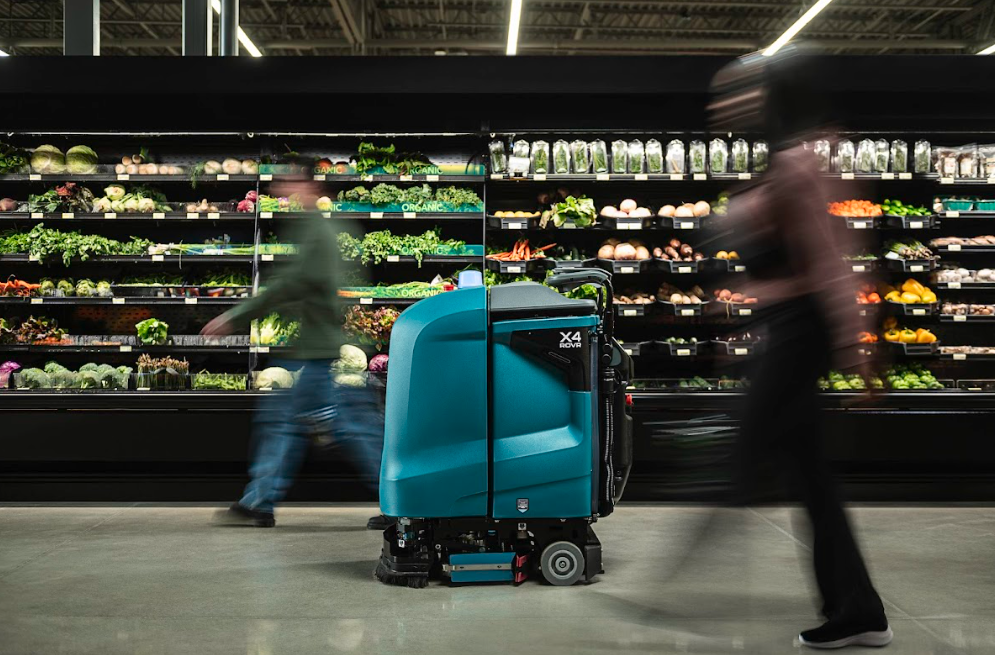
Robotics, like the autonomous floor scrubbers powered by BrainOS®, can help teams maintain consistent routines and outcomes by taking on the repetitive, time-consuming portion of floor care. The goal isn’t to remove people; it’s to reduce the operational vulnerability that comes from relying on perfect staffing conditions every shift.
2) Your team’s time goes further when repetitive work is automated
Here’s what most ROI calculators miss: not all labor hours produce the same output.
Leads and supervisors tend to deliver high productivity. Newer or high-churn roles often deliver less because ramp time, rehiring, performance variance, and rework are built into the job.
When a robot handles repetitive runs, your team can spend more time on higher-skill, higher-judgment work — details, edges, touchpoints, inspections, resets — work that directly improves service scores and contract performance.
3) Robotics can support retention through safer, smarter assignments
One of the strongest ROI angles in the BSC world is also one of the most human.
Robotics can support return-to-work programs by allowing employees with physical limitations (including pregnancy or injury-related restrictions) to remain productive while the robot handles the heavier, more monotonous work.
That helps you retain experienced people and reduce the churn costs that quietly eat margins: constant hiring, constant training, and inconsistent execution.
Where ROI gets real: The costs that quietly erode margin
Non-compliance charges and “recovery mode” operations
No-call/no-shows, missed scope, and quality failures create not only stress but direct costs.
In regions with tough hiring markets, the issue isn’t whether you can staff every role perfectly. It’s how often the plan breaks, and how expensive it is to recover. Robotics can help maintain baseline consistency so service doesn’t drop the moment a schedule changes — reducing the frequency of go-backs, penalties, and last-minute firefighting that drains profitability.
Project work: Longer-lasting results through consistent cleaning
In vinyl composition tile (VCT) environments, project work is a major investment—one you want to protect. High-quality daily and periodic cleaning helps the finish cure, wear, and age more predictably, allowing each deep-scrub-and-recoat or strip-and-wax cycle to last closer to its intended lifespan.
When floors stay cleaner between projects, your finish maintains its appearance, clarity, and durability longer, which leads to:
- Better long-term performance from each project cycle
- Extended lifespan of the wax and improved gloss retention over time
- More stable site schedules with less reactive work
It also keeps your skilled floor care teams focused on the specialized tasks where they add the most value, rather than responding to emergency recovery work which otherwise shows up as repeat trips, extra product, and added labor for the BSC..
Workers’ comp: the savings most people underestimate
In BSC operations, safety impacts the profit and loss (P&L) for years. Robots can reduce exposure to injuries like strains, sprains, and slip-and-falls by taking on a portion of physically demanding work. Over time, that can show up as fewer claims, reduced severity, and better insurance outcomes.
If you’re thinking long-term, workers’ comp is a major line of ROI.
The strategic ROI: Predictable costs in an unpredictable labor market
You already know what happens to labor costs:
- Wages climb
- Benefits pressure grows
- Local ordinances shift the economics
- Competition for reliable workers stays fierce
Robotics introduces a different kind of predictability: a planned, multi-year investment that can help you stabilize operations while labor costs and labor availability remain uncertain.
The takeaway: The best ROI story is operational resilience
If you’re evaluating robotics, the smartest question isn’t only “how fast does it pay back?”
It’s: How does this help my operation hold up when staffing, compliance pressure, and labor costs don’t cooperate? Because that’s the BSC reality.
Robotics can help you:
- Maintain consistent routines and outcomes across sites
- Reduce margin-killing disruptions like go-backs and non-compliance
- Support safer assignments that help retain experienced team members
- Improve project work quality and longevity and protect skilled labor
- Lower long-tail risk through workers’ comp outcomes
- Plan around a more predictable cost structure over time
That’s what “return” looks like when you’re building a resilient, profitable BSC operation. And it’s exactly where autonomous floor scrubbers — powered by BrainOS® — fit in: a practical way to automate repetitive floor scrubbing runs while keeping your team focused on the higher-skill work that protects service quality.
With autonomy built for dynamic environments and the operational support needed to keep programs running consistently across sites, autonomous floor scrubbers powered by BrainOS® help BSCs strengthen performance, reduce disruption, and protect margins — without compromising the role your people play in delivering great service.
Calculate the value of autonomous cleaning with Brain Corp’s ROI calculator.

