Cómo desbloquean los robots el verdadero potencial de la RFID
Los robots abordan los principales retos de la implantación de la RFID: consistencia, frecuencia y cobertura. Mediante la automatización del proceso de escaneado RFID, los minoristas pueden aprovechar toda la potencia de esta tecnología para obtener precisión en el inventario, una mejora masiva de la eficiencia y una mejor experiencia del cliente en todos los canales minoristas.


Resumen
¿Cómo desbloquean los robots el verdadero potencial de la RFID en las operaciones minoristas?
Los robots abordan los principales retos de la implantación de la RFID: consistencia, frecuencia y cobertura. Mediante la automatización del proceso de escaneado RFID, los minoristas pueden aprovechar toda la potencia de esta tecnología para obtener precisión en el inventario, una mejora masiva de la eficiencia y una mejor experiencia del cliente en todos los canales minoristas.
- RFID: la base de la gestión moderna de inventarios
- Dónde y por qué la RFID es útil para los minoristas
- Los retos de la integración de la RFID
- Cómo afrontan los robots los retos de la RFID
- El impacto de la RFID robótica en las operaciones minoristas
Contenido
La tecnología RFID utiliza ondas de radio para identificar y rastrear etiquetas adheridas a objetos. En el comercio minorista, estas etiquetas se colocan en artículos individuales, lo que permite realizar recuentos de inventario rápidos y precisos sin necesidad de un escaneado directo. A diferencia de los códigos de barras tradicionales, las etiquetas RFID pueden leerse en masa y a distancia, revolucionando la forma en que los minoristas gestionan su inventario.
Dónde y por qué la RFID es útil para los minoristas
RFID technology offers several significant advantages for retailers. Zeena Keshwji highlights some key capabilities: "With RFID, you can see effectively through things. If you have five pairs of jeans stacked up and each pair of jeans is tagged with an RFID tag, you can count the number of jeans much easier than you can with computer vision. You can approximate where a specific tag is, which helps with localization. And you can map those tags to actual products, turning them into actionable insights like 'we have five pairs of jeans left on the sales floor and we need to restock."
Estas capacidades pueden traducirse en beneficios tangibles para los minoristas:
- Profit improvements: Traditional inventory scanning's 65% inaccuracy rate reduces profits by 10%, and misplaced items account for 3.4% of all SKUs, leading to a 25% profit loss. RFID technology improves upon these figures, directly impacting a retailer's bottom line.
- Improved accuracy: RFID can achieve "greater than 95% inventory accuracy" compared to the 65% we just mentioned.
- Habilitación omnicanal: La precisión de los datos de inventario en todas las ubicaciones facilita la experiencia de compra en línea y en tienda.
- Prevención de pérdidas: Las etiquetas RFID ayudan a los minoristas a realizar un seguimiento de los artículos a lo largo de la cadena de suministro, lo que reduce la pérdida desconocida e identifica posibles puntos de robo.
- Mejora de la experiencia del cliente: Con datos de inventario precisos, los minoristas pueden satisfacer mejor las expectativas de los clientes y ofrecer información fiable sobre la disponibilidad de los productos.
The benefits of RFID in inventory extend beyond the shelves and into the supply chain, improving product availability and overall logistics efficiency.
Los retos actuales de la recogida de datos RFID
Aunque la tecnología RFID ofrece un gran potencial, su implantación en entornos minoristas se enfrenta a varios obstáculos:
- Physical limitations of manual scanning: Traditional RFID scanning requires staff to maneuver handheld devices physically, often bending and stretching to capture tags at various angles. This process is time-consuming and physically demanding, limiting the frequency and thoroughness of inventory checks.
- Time constraints: Manual RFID scanning can take hours daily, making it challenging for retailers to maintain up-to-date inventory data without significant labor investment.
- Inconsistency with scanning: The quality of manual RFID scans can vary depending on the diligence and technique of individual staff members, leading to inconsistent data collection.
- Not enough frequency of scans: Due to the labor-intensive nature of manual scanning, inventory checks are often not performed as frequently as needed for real-time accuracy.
- Insufficient coverage: Ensuring complete coverage of large retail spaces is difficult when relying on human operators, as it's easy to miss tags or entire sections.
- Data inaccuracies: Many retailers face a significant discrepancy between their system's inventory data and the actual stock on hand, a gap caused by infrequent data collection, theft, damage, misplaced items, and human error.

Cómo afrontan los robots los retos de la RFID
Aquí es donde entra en escena la robótica, que ofrece soluciones a muchos de los retos asociados a la implantación de la RFID:
- Consistency in scanning: Robots provide unwavering consistency. Zeena Keshwji explains: "The robotic solution is autonomous, which brings several benefits. The first one that comes to mind is consistency. The robot doesn't get tired, ensuring consistent performance every time it runs."
- Frequency of scans: Keshwji adds, "You can run it once a day or multiple times a day, at a much greater frequency than assigning someone to walk up and down every aisle manually scanning products with handheld scanners."
- Coverage: Robots can be programmed to systematically cover entire store layouts, ensuring no areas are missed, even in large retail spaces.
- Procesamiento de datos: Los algoritmos avanzados de IA combinados con sistemas robóticos pueden procesar datos de escaneado RFID en tiempo real, identificar patrones, predecir tendencias y señalar anomalías.
- Integration with existing systems: Many robotic solutions, like those powered by Brain Corp's BrainOS®, are designed as an autonomy platform to integrate seamlessly with existing inventory management systems, streamlining the adoption process.
El impacto de la RFID robótica en las operaciones minoristas
By combining RFID technology's power with robots' consistency and tirelessness, retailers can achieve unprecedented inventory accuracy and operational efficiency.
Las principales ventajas de esta potente combinación son:
- Eficacia operativa: Al automatizar los recuentos de inventario, el personal puede centrarse en tareas de mayor valor, como la atención al cliente y la comercialización.
- Ahorro de costes: El escaneado RFID robotizado puede reducir los costes de mano de obra a largo plazo.
- Escalabilidad: Las soluciones robóticas pueden crecer fácilmente para satisfacer las necesidades de las operaciones minoristas en expansión, lo que da una sensación de seguridad y confianza en la inversión.
- Consistent inventory visibility: Robotic RFID solutions provide constant, accurate stock data, bridging the gap between system records and actual shelf inventory.
- Mayor precisión: al eliminar los errores humanos y aumentar la frecuencia de escaneado, las soluciones RFID robotizadas pueden acercarse aún más al 100% de precisión en el inventario.
- Profit improvement: Robotic RFID solutions dramatically reduce the losses introduced by traditional manual scanning by providing near-perfect inventory accuracy and real-time item location data, directly boosting the retailer's bottom line.
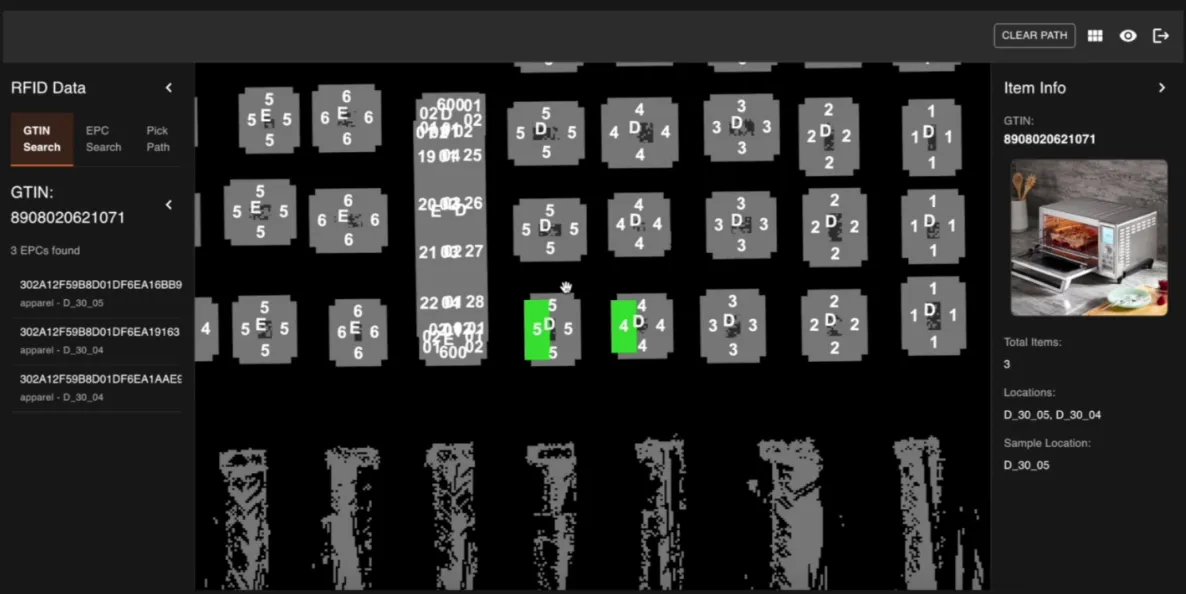
These benefits are just the beginning. There are even more ways that robots and AI can enhance inventory management that retailers might not have considered.
A medida que el panorama minorista sigue evolucionando, la combinación de RFID y robótica ofrece una potente solución a los retos de la gestión moderna de inventarios. Al aprovechar estas tecnologías, los minoristas pueden lograr una precisión, eficiencia y satisfacción del cliente sin precedentes.
Zeena Keshwji emphasizes Brain Corp's unique position in the market: "We have a lot of experience based on data, based on actual operation in public spaces, that goes into every one of our products. I think that's our differentiator that makes us stand out compared to other options."
Are you ready to enhance your inventory management with robotic RFID solutions? Contact Brain Corp today for a personalized assessment of how our advanced robotics and AI can improve your retail operations. Let's build a smarter, more efficient future for your business.
Q&A
Question: What is RFID and why is it foundational for modern retail inventory management?
Short answer: RFID uses radio waves to identify and track tagged items without line-of-sight, enabling fast, bulk reads and approximate localization. Unlike barcodes, RFID can “see through” stacked products (e.g., multiple pairs of jeans) and map each tag to a specific product. This turns raw reads into actionable insights like “we have five pairs left on the sales floor and need to restock,” which supports accurate, real-time visibility across channels.
Question: If RFID is so powerful, why do retailers still struggle to get accurate inventory?
Short answer: Most friction comes from how RFID data is collected. Manual handheld scans are physically demanding, time-consuming, inconsistent across staff, and too infrequent to keep data fresh. Large stores are hard to cover completely, so tags and even whole sections get missed. These gaps—compounded by theft, damage, misplaced items, and human error—create the discrepancy between system inventory and what’s actually on the shelf.
Question: How do robots address the key challenges of RFID implementation?
Short answer: Robots deliver consistency, frequency, and coverage. They don’t fatigue, so scan quality stays high run after run; they can scan once or even multiple times daily; and they methodically cover entire store layouts. Paired with AI, they process data in real time to flag patterns and anomalies. Many solutions, including those on Brain Corp’s BrainOS® autonomy platform, integrate with existing inventory systems to streamline adoption.
Question: What business results can retailers expect from robotic RFID?
Short answer: Expect higher accuracy, real-time visibility, and efficiency. Traditional inventory scanning’s 65% inaccuracy can reduce profits by 10%, and 3.4% of SKUs being misplaced can drive a 25% profit loss. RFID alone can achieve greater than 95% inventory accuracy; robotic RFID increases scan frequency and consistency to push accuracy even closer to 100%. This translates into operational efficiency (staff shift to customer-facing work), cost savings, scalability across locations, and direct profit improvement.
Question: How does this fit into enterprise autonomy strategies, and what differentiates Brain Corp?
Short answer: Deploying RFID on autonomous mobile robots (AMRs) closes the autonomy gap in physical automation and supports enterprise autonomy strategies powered by physical AI. Brain Corp’s BrainOS® provides an autonomy platform that integrates with existing systems, and the company highlights its extensive real-world operational experience in public spaces as a key differentiator embedded in its products.