ロボットがRFIDの真の可能性を引き出す方法
ロボットは、RFID導入における重要な課題である一貫性、周波数、カバレッジに対応する。RFIDのスキャニングプロセスを自動化することで、小売企業は、在庫の正確性、効率の大幅な改善、すべての小売チャネルにおけるより良い顧客体験のために、このテクノロジーのフルパワーを活用することができます。


概要
小売業務におけるRFIDの真の可能性を、ロボットはどのように解き放つのか?
ロボットは、RFID導入における重要な課題である一貫性、周波数、カバレッジに対応する。RFIDのスキャニングプロセスを自動化することで、小売企業は、在庫の正確性、効率の大幅な改善、すべての小売チャネルにおけるより良い顧客体験のために、このテクノロジーのフルパワーを活用することができます。
- RFID:最新の在庫管理の基礎
- RFIDが小売業者の役に立つ場所と理由
- RFID統合の課題
- ロボットはRFIDの課題にどう対処するか
- ロボットRFIDが小売業に与える影響
内容
RFID技術は、電波を利用して物体に取り付けられたタグを識別・追跡する。小売業では、これらのタグは個々の商品に貼付され、直接視線を通さずに迅速かつ正確に在庫を数えることができる。従来のバーコードとは異なり、RFIDタグは一括して、また離れた場所から読み取ることができるため、小売業者の在庫管理方法に革命をもたらす。
RFIDが小売業者の役に立つ場所と理由
RFID technology offers several significant advantages for retailers. Zeena Keshwji highlights some key capabilities: "With RFID, you can see effectively through things. If you have five pairs of jeans stacked up and each pair of jeans is tagged with an RFID tag, you can count the number of jeans much easier than you can with computer vision. You can approximate where a specific tag is, which helps with localization. And you can map those tags to actual products, turning them into actionable insights like 'we have five pairs of jeans left on the sales floor and we need to restock."
これらの能力は、小売業者にとって具体的な利益につながる:
- Profit improvements: Traditional inventory scanning's 65% inaccuracy rate reduces profits by 10%, and misplaced items account for 3.4% of all SKUs, leading to a 25% profit loss. RFID technology improves upon these figures, directly impacting a retailer's bottom line.
- Improved accuracy: RFID can achieve "greater than 95% inventory accuracy" compared to the 65% we just mentioned.
- オムニチャネルの実現:全店舗の正確な在庫データが、オンラインと店舗でのシームレスなショッピング体験をサポートします。
- ロス防止:RFIDタグは、小売業者がサプライチェー ン全体を通して商品を追跡し、シュリンクを削減し、盗難 の可能性のあるポイントを特定するのに役立つ。
- 顧客体験の向上:正確な在庫データにより、小売業者は顧客の期待に応え、信頼性の高い商品在庫情報を提供することができます。
The benefits of RFID in inventory extend beyond the shelves and into the supply chain, improving product availability and overall logistics efficiency.
RFIDデータ収集の現在の課題
RFID技術は大きな可能性を秘めているが、小売環境での導入にはいくつかのハードルがある:
- Physical limitations of manual scanning: Traditional RFID scanning requires staff to maneuver handheld devices physically, often bending and stretching to capture tags at various angles. This process is time-consuming and physically demanding, limiting the frequency and thoroughness of inventory checks.
- Time constraints: Manual RFID scanning can take hours daily, making it challenging for retailers to maintain up-to-date inventory data without significant labor investment.
- Inconsistency with scanning: The quality of manual RFID scans can vary depending on the diligence and technique of individual staff members, leading to inconsistent data collection.
- Not enough frequency of scans: Due to the labor-intensive nature of manual scanning, inventory checks are often not performed as frequently as needed for real-time accuracy.
- Insufficient coverage: Ensuring complete coverage of large retail spaces is difficult when relying on human operators, as it's easy to miss tags or entire sections.
- Data inaccuracies: Many retailers face a significant discrepancy between their system's inventory data and the actual stock on hand, a gap caused by infrequent data collection, theft, damage, misplaced items, and human error.

ロボットはRFIDの課題にどう対処するか
そこでロボット工学が登場し、RFID導入に伴う多くの課題に対するソリューションを提供する:
- Consistency in scanning: Robots provide unwavering consistency. Zeena Keshwji explains: "The robotic solution is autonomous, which brings several benefits. The first one that comes to mind is consistency. The robot doesn't get tired, ensuring consistent performance every time it runs."
- Frequency of scans: Keshwji adds, "You can run it once a day or multiple times a day, at a much greater frequency than assigning someone to walk up and down every aisle manually scanning products with handheld scanners."
- Coverage: Robots can be programmed to systematically cover entire store layouts, ensuring no areas are missed, even in large retail spaces.
- データ処理:ロボットシステムと組み合わされた高度なAIアルゴリズムは、RFIDスキャンデータをリアルタイムで処理し、パターンを特定し、傾向を予測し、異常にフラグを立てることができる。
- Integration with existing systems: Many robotic solutions, like those powered by Brain Corp's BrainOS®, are designed as an autonomy platform to integrate seamlessly with existing inventory management systems, streamlining the adoption process.
ロボットRFIDが小売業に与える影響
By combining RFID technology's power with robots' consistency and tirelessness, retailers can achieve unprecedented inventory accuracy and operational efficiency.
この強力な組み合わせの主な利点は以下の通り:
- 業務の効率化: 在庫カウントを自動化することで、スタッフはカスタマーサービスやマーチャンダイジングなど、より価値の高い業務に集中することができる。
- コスト削減:ロボットRFIDスキャンは、長期的な人件費を削減することができます。
- 拡張性:ロボットソリューションは、拡大する小売業務のニーズに合わせて容易に成長できるため、投資に対する安心感と信頼感が得られる。
- Consistent inventory visibility: Robotic RFID solutions provide constant, accurate stock data, bridging the gap between system records and actual shelf inventory.
- 精度の向上:人為的ミスを排除し、スキャン頻度を高めることで、ロボットRFIDソリューションは在庫の精度を100%に近づけることができる。
- Profit improvement: Robotic RFID solutions dramatically reduce the losses introduced by traditional manual scanning by providing near-perfect inventory accuracy and real-time item location data, directly boosting the retailer's bottom line.
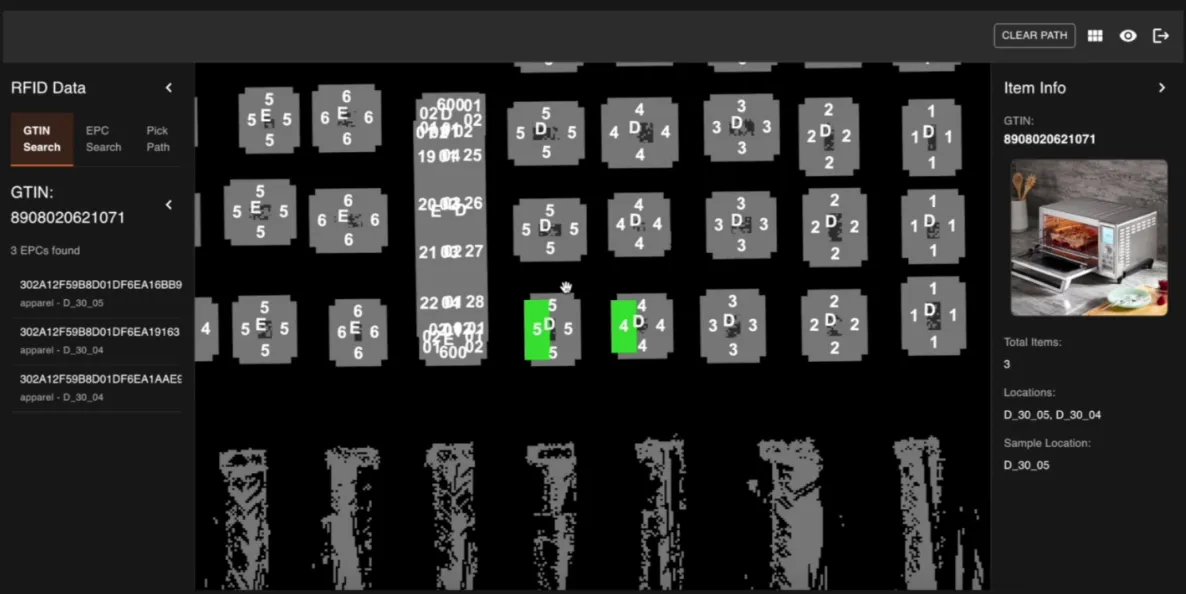
These benefits are just the beginning. There are even more ways that robots and AI can enhance inventory management that retailers might not have considered.
小売業が進化を続ける中、RFIDとロボット工学の組み合わせは、現代の在庫管理の課題に対する強力なソリューションを提供します。これらのテクノロジーを活用することで、小売業者はこれまでにない正確さ、効率性、顧客満足度を実現することができる。
Zeena Keshwji emphasizes Brain Corp's unique position in the market: "We have a lot of experience based on data, based on actual operation in public spaces, that goes into every one of our products. I think that's our differentiator that makes us stand out compared to other options."
Are you ready to enhance your inventory management with robotic RFID solutions? Contact Brain Corp today for a personalized assessment of how our advanced robotics and AI can improve your retail operations. Let's build a smarter, more efficient future for your business.
Q&A
Question: What is RFID and why is it foundational for modern retail inventory management?
Short answer: RFID uses radio waves to identify and track tagged items without line-of-sight, enabling fast, bulk reads and approximate localization. Unlike barcodes, RFID can “see through” stacked products (e.g., multiple pairs of jeans) and map each tag to a specific product. This turns raw reads into actionable insights like “we have five pairs left on the sales floor and need to restock,” which supports accurate, real-time visibility across channels.
Question: If RFID is so powerful, why do retailers still struggle to get accurate inventory?
Short answer: Most friction comes from how RFID data is collected. Manual handheld scans are physically demanding, time-consuming, inconsistent across staff, and too infrequent to keep data fresh. Large stores are hard to cover completely, so tags and even whole sections get missed. These gaps—compounded by theft, damage, misplaced items, and human error—create the discrepancy between system inventory and what’s actually on the shelf.
Question: How do robots address the key challenges of RFID implementation?
Short answer: Robots deliver consistency, frequency, and coverage. They don’t fatigue, so scan quality stays high run after run; they can scan once or even multiple times daily; and they methodically cover entire store layouts. Paired with AI, they process data in real time to flag patterns and anomalies. Many solutions, including those on Brain Corp’s BrainOS® autonomy platform, integrate with existing inventory systems to streamline adoption.
Question: What business results can retailers expect from robotic RFID?
Short answer: Expect higher accuracy, real-time visibility, and efficiency. Traditional inventory scanning’s 65% inaccuracy can reduce profits by 10%, and 3.4% of SKUs being misplaced can drive a 25% profit loss. RFID alone can achieve greater than 95% inventory accuracy; robotic RFID increases scan frequency and consistency to push accuracy even closer to 100%. This translates into operational efficiency (staff shift to customer-facing work), cost savings, scalability across locations, and direct profit improvement.
Question: How does this fit into enterprise autonomy strategies, and what differentiates Brain Corp?
Short answer: Deploying RFID on autonomous mobile robots (AMRs) closes the autonomy gap in physical automation and supports enterprise autonomy strategies powered by physical AI. Brain Corp’s BrainOS® provides an autonomy platform that integrates with existing systems, and the company highlights its extensive real-world operational experience in public spaces as a key differentiator embedded in its products.