From accuracy to advantage: The new economics of inventory intelligence
Inventory accuracy isn’t just an operational metric — it’s an economic lever that affects sales, forecasting, and brand trust. The 2025 IHL Shelf Intelligence Report shows retailers are losing massive value to record-to-shelf mismatches, and higher-frequency, AI-powered scanning is the most scalable way to improve accuracy and ROI.

Résumé
What if inventory accuracy is less of a metric — and more of a profit lever?
The 2025 IHL Shelf Intelligence Report shows record-to-shelf mismatches are draining massive value from retailers, while higher-frequency, AI-powered inventory scanning makes accuracy repeatable, scalable, and ROI-driven.
Contenu
Retail has always run on a simple assumption: if you know what you have, you can sell what you have. But the new data suggests something more interesting — and more uncomfortable: The industry misunderstands the economic behavior of accuracy itself.
Inventory accuracy doesn’t behave like a static metric. It behaves like a variable cost of capital. It rises, falls, compounds, and influences every other performance indicator around it.
According to the 2025 Shelf Intelligence Report by IHL Group, the industry is operating with distortion levels large enough to reshape entire business models: more than $1.7 trillion globally, roughly 5% of retail revenue disappearing into mismatches between system records and shelf reality.
That number is staggering on its own, but the real story sits underneath it: accuracy is a financial lever, and one most retailers haven’t optimized yet.
1. Accuracy is an economic signal
One of the more striking findings in the report is how wide the gap is between perception and reality. Across retailers surveyed, on-shelf availability averages 58%, planogram accuracy 57%, and promotional compliance 60%. Only 22% of retailers reach even 80% accuracy in any of these areas. Viewed operationally, that’s a problem. Viewed economically, that’s a distortion event.
Every gap creates a second-order cost:
- A lost sale is not only lost revenue; it undermines demand forecasting.
- A mislabeled promotional item doesn’t only disappoint a shopper; it erodes a brand’s understanding of their trade spend.
- A misaligned planogram doesn’t only cause out-of-stocks; it scrambles category insights.
The report shows the downstream effects clearly: 50% of retailers lose sales, 47% lose customer trust, 47% lose future brand engagement, and 65% strain vendor relationships because of inventory issues.
These are degraded economic signals echoing through every part of the business.
2. The mechanical advantage of high accuracy
Here’s where things get interesting: accuracy behaves like a force multiplier. When accuracy improves in one area, the system becomes more predictable somewhere else.
The IHL report demonstrates this through several compounding relationships:
Retailers with stronger promotional compliance (70%+) are 17x more likely to achieve higher on-shelf availability. Those same retailers are 61% more likely to earn high brand trust. Teams with strong cross-functional alignment post 12% higher compliance across the board and 17% higher trust with partners.
What’s happening is basic systems engineering: reduce friction in one node, and its connected nodes stabilize. Inventory accuracy, in other words, is a central stabilizing variable.
3. The math of frequency breaks before the economics do
Every retailer wants higher accuracy, and the IHL report quantifies this desire: 88% want inventory checks weekly or more, and nearly half want multiple checks per week or daily.
The problem: the math gives out long before the benefits do. Thousands of SKUs x multiple checks per week x human variability = a workload that can only scale linearly, not exponentially.
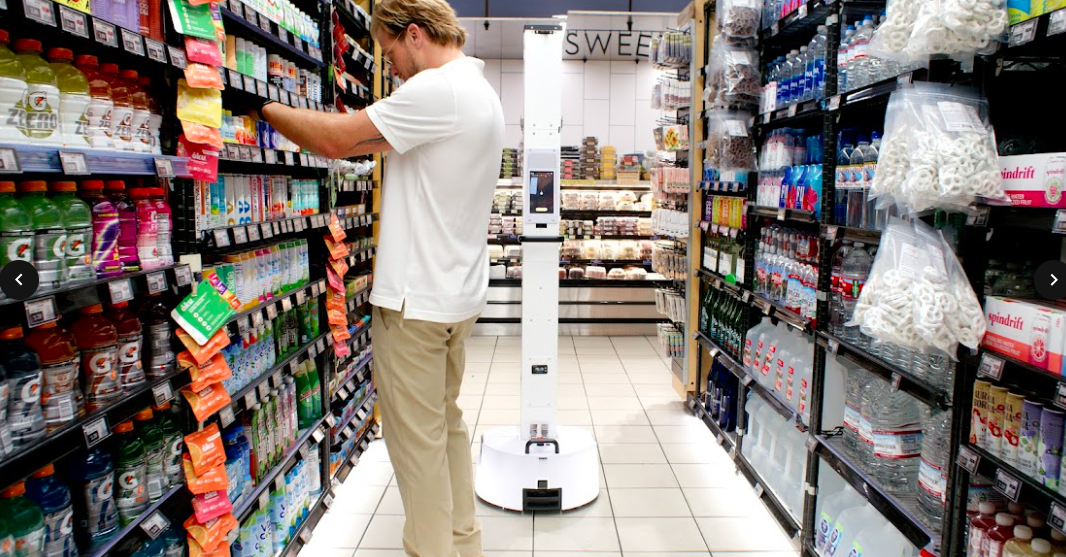
This is why retailers identify AI-powered robotics as the #1 most influential technology for helping with this challenge: automation increases frequency without increasing cost-per-check, and it eliminates the reliability variance of human-led processes.
In short: robotics gives accuracy an actual economic curve — one that bends toward predictability instead of labor strain.
4. The shift from loss prevention to value creation
Most conversations about accuracy historically lived in the world of shrink, compliance, and operational cleanup. But the Shelf Intelligence Report reveals something that reframes the entire conversation: 89% of retailers believe shelf data can generate new revenue — if it’s accurate and 76% say brands will only pay for it if accuracy is high. That’s a profound shift. It means accuracy has crossed a threshold from cost avoidance to value creation.
This turns inventory intelligence into a multi-layer ROI engine:
- Higher on-shelf availability feeds direct revenue.
- Reduced manual labor lowers recurring operational costs.
- High-quality shelf data becomes a monetizable asset.
You don’t get many categories of operational work that simultaneously reduce cost, increase revenue, and open new income streams. Accuracy is one of them.
5. How Brain Corp fits into the new economics
What the IHL report also makes clear is that retailers want the benefits of robotic inventory scanning — but not always the burden.
- 33% prefer to own and manage robots directly.
- 67% prefer a service-driven approach.
Both mindsets are rational; they just optimize for different economic conditions.
- Dedicated inventory scanning robots
This option fits organizations that want precision plus control. They run the cadence, decide the workflows, and treat inventory scanning as part of their operational infrastructure. It behaves like a capital asset with compounding value.
- Scanning-as-a-Service (with ShelfOptix™)
This model aligns with retailers who want accurate data without managing the robot that produces it. No capex. No store-level operational lift.
Here, the economic value comes from shifting robotics from asset ownership to an outsourced accuracy function.
Both models share the same intent: make shelf data reliable, repeatable, and economically productive.
6. The new economics of advantage
What emerges from the report is a new equation for modern retail.High accuracy stabilizes everything it touches; poor accuracy destabilizes everything it informs.
Retailers who treat inventory intelligence as infrastructure, not inspection, unlock a different economic trajectory. Better forecasting, better brand partnerships, better promotional ROI, better category insights, higher revenue, and better customer experiences. customers.
Accuracy is no longer the cost of doing business. It’s the cost of competing, and increasingly, it’s the cost of winning. Want to calculate your ROI of inventory scanning? Use our ROI calculator.